

When talking about war, we really like to bring up how so-and-so war “happened for no reason.” That’s an important point to make, too. War rarely accomplishes more than spreading misery for those caught in the crossfire. But this week, we’re going to look at one war that really, really didn’t need to take place.
Let’s discuss the 1925 war which came about because of one stray dog: the “Incident at Petrich,” or the “War of the Stray Dog.”
Background
To understand what conditions allowed the War of the Stray Dog to come about, we need to look at the relationship between Greece and Bulgaria in the early 20th century.
In 1925, Greece and Bulgaria were both former parts of the Ottoman Empire. The Empire had been coming apart for years, with these two nation-states gaining independence decades before its ultimate collapse in 1922. As is usually the case when an empire shatters, new independent states found new problems.
Bulgaria and Greece developed bad blood during the Second Balkan War, which displayed a lot of Bulgaria’s aggression, and during World War I when the two nations picked different sides. While Bulgaria went with Germany and its compatriots, Greece chose to side with the Allies. When the Great War ended with an Allied victory, Greece was rewarded for its allegiance. Bulgaria? Not so much.
The Allied victory brought no small amount of geopolitical changes to Europe. In Bulgaria’s case, they lost land to their neighbors, with Greece being one of them. This didn’t sit well with the Bulgarians, especially the more extreme revolutionary factions. Raids and border skirmishes were common. Feelings between these two nations weren’t positive, to say the least.
The Incident at the Border
On the border between Bulgaria and Greece, the Kemir Kapou Pass would allegedly be the site of this historical event (Russell, 2016). It was October 18, 1925, and tensions were still high. Chaos would erupt as a result of a single variable: a stray animal.
The stories of what happened that day are diverse, so we’ll look at what is generally agreed upon. A Greek soldier stationed at the border was the owner of a dog. For a reason still unknown to this day, the dog bolted away and over the border into Bulgarian land.
Now, the idea of an armed soldier rushing across the border in order to catch his dog is concerning enough. It becomes even more so when you consider that these countries were already incredibly hostile—remember that skirmishes along the border weren’t infrequent. Despite this, the Greek soldier ran after his dog. When you think about it, it’s actually a very heartwarming thought that a soldier would put himself at such risk for his companion. But then again, perhaps he simply wasn’t thinking straight. The end result was the same.
It all happened in an instant. When the Bulgarian soldiers saw the Greek trespasser rushing straight over the border, they acted quickly and without compromise. The Greek soldier was shot dead. The violence didn’t stop there, as the Greek and Bulgarian men began to exchange shots at each other as everything went to high hell.
Amidst the hostility, one Greek captain tried to signal a mutual ceasefire using a white sheet. His plea was ignored, and the captain too was shot. At that point, the incident simply could not be contained. Word would reach the Greek government, and action would be taken. All because of one dog.
The War of the Stray Dog
Word of the murder at the border swept through the Greek press. In response, Bulgaria’s government tried to convince their neighbor that the event was nothing more than a tragic misunderstanding. But the current Greek administration was having none of it. Under different leadership, peace might have been negotiated upfront, yet that wasn’t the case.
At the time of the incident, Greece’s leader was Lieutenant General Theodoros Pangalos. The man had only just recently deposed Greece’s King Constantine I as part of a coup. He was calling Greece at the time the “Second Hellenic Republic.” Pangalos was not what you would call a nice man. Your typical authoritarian, he centralized power around himself and weakened his opposition. He also attacked the freedom of the press and devalued Greece’s currency. This was the man in charge of Greece when one dog got Greek soldiers killed, and it went over as well as you might expect.

Pangalos gave the Bulgarians a 48-hour ultimatum: a formal apology, punishment for the soldiers involved, and a hefty compensation of two million French francs, lest they incur the consequences. In response to Bulgaria’s refusal, Pangalos sent out his troops on October 22.
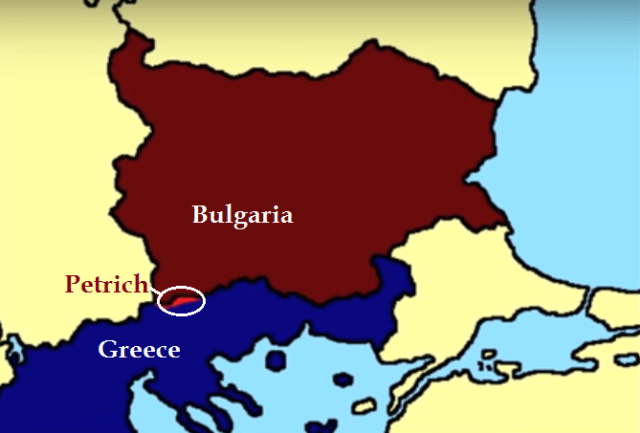
The fighting was centralized around the Bulgarian town of Petrich, which was swiftly occupied by the Greeks. Close to fifty Bulgarians lost their lives, in addition to the Greek losses. Of course, civilians were among those caught in the chaos.
The League of Nations got wind of the Greek-Bulgarian conflict and demanded a resolution. Greece was to immediately withdraw its troops and pay reparations to Bulgaria for their actions. Pangalos was upset with this, especially since he felt the League was unfairly siding with Bulgaria, but he didn’t have the resources to defy the League of Nations.
Theodoros Pangalos complied, the Greek military returned home, and the “war” ended after only ten days. One year later, Pangalos was deposed himself and imprisoned in the Izzeddin Fortress.
But What About the Pup?
This conflict between Greece and Bulgaria ended about as quickly as it started. Even so, lives were lost as a result. And why was that, again? Oh, yes—all because of a stray dog.
Well, not entirely. Hostilities were extremely high between the countries. Small clashes at the border were nothing new. The incident on October 18 may have been especially bloody and needless, but can we truly put all the blame on those conditions alone? With how troublesome things were, who’s to say it wasn’t inevitable for such a case to eventually happen and cause the tension to boil over?
What about the dog, anyway? What happened to it? The truth is, no one really knows. There are no accounts detailing what kind of dog it was, why it did what it did, and what happened to it after the war. We can’t exactly blame historians for this, as the conflict itself was of much greater concern to the Greek people. The dog may have vanished, or perhaps it found itself a new owner after everything was said and done. We may never know.
Despite all that happened, we can at least be grateful that the incident did not escalate into a much greater conflict. While Europe would soon have to face the darkness of the Second World War, for the time at least, Greece and Bulgaria didn’t need to lose much more. The tragic casualties in 1925 were regrettable enough.
And as for the dog, well… let’s just hope it found a proper new home.
— r
Further reading:
For a study of this event that goes more into the historical background, check out this article by Shahan Russell.
To learn about some really special dogs, read this article about acclaimed military dogs who’ve left their mark on the world—including one who was in well over a dozen battles!

 Mysterious History