
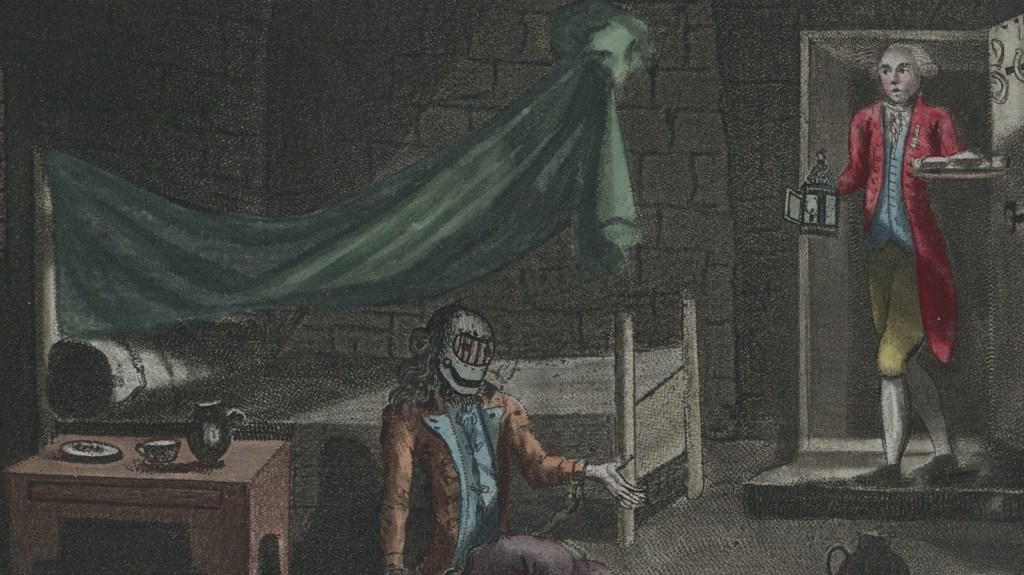
“What are you in for?” This is what we like to say prisoners ask each other when they meet their cellmates. Every prisoner, no doubt, must have their own fascinating story to tell. But what if you found that your cellmate was a guy with an iron mask attached to his face? What kind of outlandish story could possibly explain the reasoning for that?
Of course, we aren’t talking about everyday prisons here. We’re talking about 17th-century France. We also aren’t talking about your average country jail, but instead the Bastille, King Louis XIV’s dustbin for upper-class prisoners. So you have a high-level prisoner who’s important enough to be held in places like the Bastille, and who seemingly always wears an iron mask. And did I mention he was imprisoned for at least 34 years?
Meet the “Man in the Iron Mask,” a peculiar mystery which has stood the test of time for more than three centuries. Who was this guy? Why was he locked up? Why, oh why was he kept wearing a mask? Could all of these questions have the same answer, perhaps?
Let’s delve into the tale of this French “Iron Man” and see if we can unmask the truth.
Analyzing the Legend
We’ll start with the facts that we know and the details we believe to be most accurate. In the late 17th century, a most unusual prisoner was kept in several French prisons. The most notable of these were in Pignerol and, as mentioned earlier, the Bastille. We can note three interesting distinctions about this stranger’s incarceration:
Firstly, of course, there was the iron mask he allegedly wore to conceal his face.
Secondly, he was always supervised by the prison governor Bénigne Dauvergne de Saint-Mars. Saint-Mars was effectively his warden for the remainder of the prisoner’s life, adding up to over three decades
Thirdly, there were strangely specific rules from the highest authority in France about what the man was allowed to do. He was treated rather lavishly and could ask for much, but speaking aloud about anything unrelated to his immediate needs would get him killed. Saint-Mars would see him once a day to provide whatever he needed.
We can already see a strange contradiction beginning to form. If this prisoner was restricted in what he could say and had to wear an iron mask, why was he given so much leniency and freedom? What kind of person was deemed worthy of such comfortable accommodations while also being bound to a mask?
The Man in the Iron Mask died in the Bastille on November 19, 1703, and he was buried the following day. After all those years as a prisoner of state, still no one knew for certain who he was—at least the people who were willing to admit it.
Guess Who?
What can we say in regards to the true identity of the Man in the Iron Mask? What do we know?
It is said that when the masked prisoner was first sent to prison in Pignerol in 1669, his name was given as “Eustache Dauger.” This doesn’t exactly add up with the name he was given when he was buried decades later, which was “Marchioly.” Just as well, why do we know nothing of what his crimes were? Combine that with the mask he had to wear, and we can see that getting to the truth won’t be as simple as reading historical accounts.
The three centuries and more since the masked prisoner’s death have made room for plenty of theories. There are several political prisoners considered possible candidates for the Man in the Iron Mask’s identity.
One idea is that he was an Italian count named Ercole Antonio Mattioli, who had worked with France’s enemies in Spain. Records say that Mattioli was indeed held in Pignerol and Sainte-Marguerite, where the Man in the Iron Mask was also kept. However, no record mentions Mattioli being at the Bastille, for instance, which would dispute this claim.
Another claim is that the Man in the Iron Mask might have been the disgraced French General Vivien de Bulonde. His imprisonment was ordered by Louis XIV after he abandoned wounded men at the Siege of Cuneo. Some who have studied the ciphers used in this time believe a letter from Louis XIV may have required Bulonde to wear a mask, but this has not been confirmed. Bulonde’s recorded death also came years after that of the masked prisoner.
A popular and fantastical theory from The Vicomte of Bragelonne: Ten Years Later, written by Alexandre Dumas, is that the Man in the Iron Mask was actually the brother of Louis XIV, forced to wear a mask to conceal his resemblance. Popular culture seems to like this theory, and it was even used in the plot of the 1998 film The Man in the Iron Mask. Only, in that film, the man behind the mask is Leonardo DiCaprio, which I think would’ve shocked the French aristocracy back then.
Unmasking the Truth
Now, for the moment you’ve all been waiting for. It’s time to unveil the mystery of the the iron mask:
It was never an iron mask to begin with. It was actually made of velvet cloth, and the French writer Voltaire’s description of it led to this popular misconception. So any illustrations you see depicting the prisoner as looking like Iron Man are completely false.
Yes, that’s it. Quite frustratingly, addressing the error of the mask’s material is the closest I can get to “unmasking” this historical mystery. Even after all these years, we still don’t know for sure whose face was behind it all. If you see anyone call him the “Man in the Iron Mask,” at least you can correct them and say how he was, actually, the “Man in the Cloth Mask.” Doesn’t sound as cool, though.
We’ve arrived at more or less where we started. We know that there was a prisoner long ago who wore a mask, and no one knows for certain who he truly was. Will we ever truly know? At the very least, historical records are still being rediscovered and analyzed, so the chance that we might one day learn the truth is never zero. Perhaps we will eventually find out whose face lies behind that mask. If that day comes, we can finally get rid of that troublesome, awesome nickname, the “Man in the Iron Mask,” and trade it for a comfortable, normal name like “François.”
On second thought, maybe we should keep the nickname.
— r
Further reading:
The mystery goes deeper and deeper—consider reading this extensive article by History Extra discussing the Man in the Iron Mask and more possible explanations.

 Mysterious History