
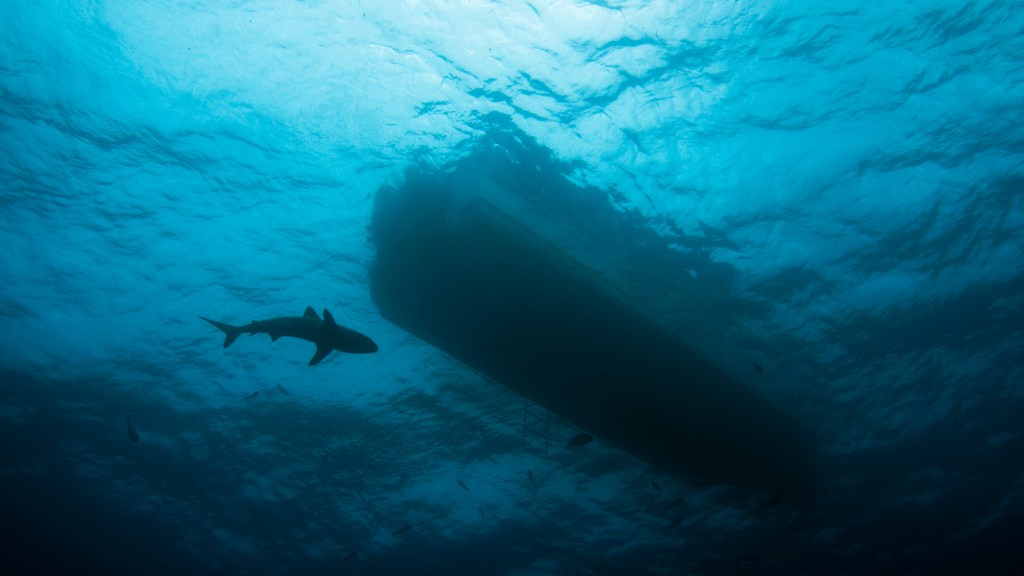
Are you afraid of the ocean? Have you ever thought about how deep, dark, and filled with unseen creatures it is? If the deep blue which encompasses over 70% of our world unnerves you, then you’re not alone. Many people suffer from thalassophobia, or a fear of the sea.
A second question: are you afraid of strange sounds? Are you kept awake at night by bumps and other untraceable noises? The likelihood is that you are, as every human has some fear of the unknown. What we can’t see, we can’t fully understand.
Now let’s combine those two fears. Many fear the deep ocean because they are haunted by what might be lurking beneath. But what happens when we hear a call from the deep? (Not the “call of the deep,” commonly attributed to nitrogen narcosis, which we might cover on this blog one day.)
As human technology has advanced, we have created powerful sonar technologies which can hear even into the deep ocean. Through the use of hydrophones, which are specifically designed to record underwater sounds, we can hear (some of) the things that happen beneath the blue.
Not all of them are pleasant to hear.
The Bloop
The “Bloop” is perhaps the most well-known mysterious underwater sound. In 1997, the U.S. National Oceanic and Atmospheric Administration (NOAA) captured an ultra-low-frequency, enormously powerful sound from the deep ocean.
Have a listen for yourself. This is the Bloop at 16x its original speed:
The Bloop was traced to somewhere in the Pacific Ocean near South America’s southernmost tip. Because the audio of the Bloop resembles that of an animal, many listeners came to believe that a living creature was responsible for the noise. However, because of the sheer volume of it, the Bloop would have to have been made by an animal even larger than the blue whale, Earth’s biggest known creature.
Is it possible that a marine creature of unparalleled size is lurking somewhere deep in the ocean?
While the possibility is indeed there, especially considering how little we know of the ocean, the Bloop may have a simpler explanation. The scientific community largely agrees that the Bloop was most likely created by shifting sea ice, such as an icequake or a massive iceberg hitting the sea floor.
This is a win for those afraid of what might lie in the depths of our oceans. For everyone else, it might disappointingly dash their fantasies of a gargantuan sea kaiju. Even so, never lose hope!
Julia
“Julia” is the name given to another strange underwater sound recorded by NOAA in 1999. Like the Bloop, Julia was extraordinarily loud and had a peculiar sound.
Take a moment to listen to Julia, again at 16x speed:
Unnerving to listen to, isn’t it? In case it wasn’t clear, the noise seems almost to be saying “Julia,” which is how this sound got its name. There’s a point to be made on how natural sounds resembling human speech accidentally makes them more creepy. Still, the fact that this sound was heard at all is curious enough.
We have less of a clear idea on where Julia came from, save that it was likely around the northern edge of Antarctica. Much like the Bloop, scientists believe that the sound was caused by a massive iceberg.
The Upsweep
The “Upsweep” differs from the Bloop and Julia in an important way. While most unexplained sounds from the deep are one-and-done, the Upsweep has been going on consistently at least since it was detected by NOAA’s Sound Surveillance System (SOSUS) in 1991. It’s very possible that it could have been going on long before.
Listen now to the Upsweep at 20x its original speed:
Let’s see what NOAA has to say about the Upsweep:
“[The Upsweep] consists of a long train of narrow-band upsweeping sounds of several seconds duration each. The source level is high enough to be recorded throughout the Pacific. It appears to be seasonal, generally reaching peaks in spring and fall, but it is unclear whether this is due to changes in the source or seasonal changes in the propagation environment.” (National Oceanic and Atmospheric Administration)
It is believed that the sound is coming from a point between New Zealand and the bottom tip of South America, and not too far from Antarctica. Though its origin is believed to be volcanic, scientists still do not know for sure. One interesting detail is that though it can still be heard today, the Upsweep’s intensity has been slowly declining ever since it was first detected.
Who knows what could be going on down there?
Wait, So No Sea Monsters?
There are plenty of other strange underwater sounds to choose from, but there are already some commonalities between these three. They are commonly attributed to moving sea ice and other such geographical phenomena. After all, is it really a coincidence that all of these sounds are coming from Antarctica, the sea ice capital of the world?
Don’t let this fool you into thinking that we’ve found everything interesting in the ocean already, though. The truth is that we’ve mapped only about a fifth of our ocean, and we’ve personally explored even less than that. The deep sea is a strange place that we, as terrestrial mammals, are not built to explore. Who knows if we will ever truly conquer it?
This is not our planet alone. There’s a whole other world right beneath us, unseen in the dark and blue. Humans fear the unknown, and perhaps rightfully so.
— r
Further reading:
Visit NOAA’s online page that displays some sea audio, including one we’ve touched on here. Their entire website is deserving of exploration by itself!

 Mysterious History