
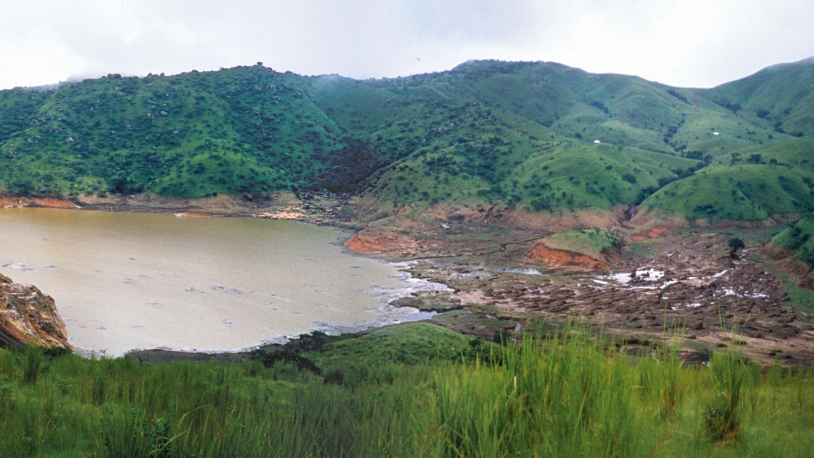
Imagine a tranquil morning in a picturesque, unassuming valley. The sun lazily rises above Lake Nyos, a crater lake in northwest Cameroon, casting a warm, golden hue over the lush green landscape. It was the morning after August 21, 1986, a day that had begun and ended like any other. But something was wrong. There was no chirping of birds. There was no braying of farm animals. Even the insects had ceased their calls. Beasts of burden, wild animals, insects, and close to two thousand humans lay dead in the land surrounding Lake Nyos.
They had died without warning. And their killer? A silent disaster.
Nestled in the Northwest Region of Cameroon, Lake Nyos is a deep lake cradled by the volcanic mountains of the region. On that day, its serene surface had belied the horrors that lay beneath. Unbeknownst to the locals, the lake was a ticking time bomb, harboring a deadly payload of carbon dioxide (CO2)—a vault of magma—that had been building up for centuries.
On that ill-fated day in 1986, the “beast” of Lake Nyos woke from its slumber. The exact cause of the gas’s release is unknown, though most scientists suspect it was a side-effect of either a landslide or a volcanic eruption. It is believed that a wave twenty-five meters high or more spewed forth from the lake as a result of the outgassing. It swept the shore harmlessly, but the water itself was not the killer. Instead, it was the mist.
The mist brought the cluster of CO2 which had been building up for centuries onto the mainland. Because CO2 is heavier than air, it lurked along the ground as it swept into the nearby villages, like a supernatural fog out of an old ghost story. It seeped into homes, low-lying areas, and suffocated everything in its path. The gas was so deadly that most people simply suffocated to death in their sleep.
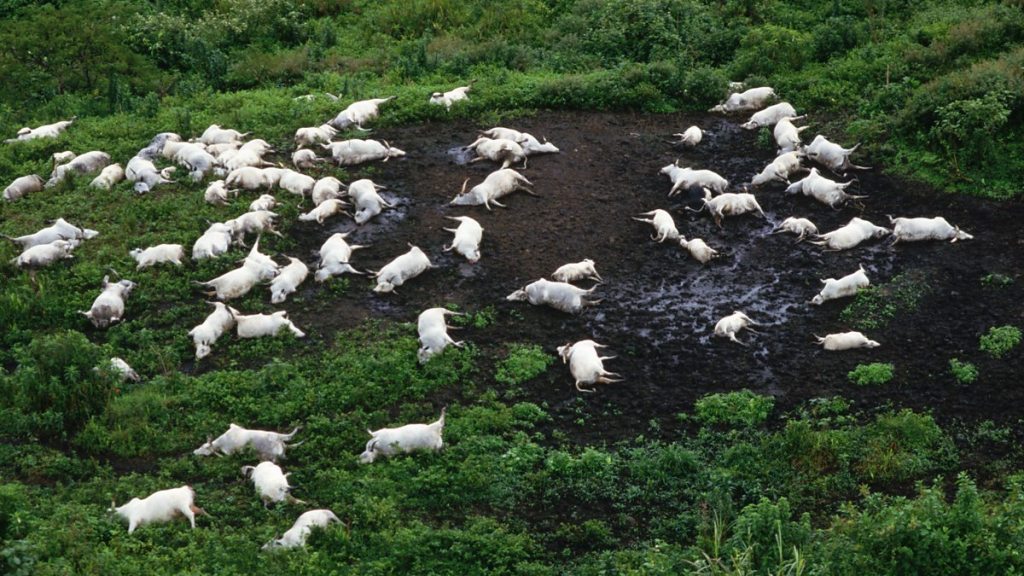
In mere moments, over 1,700 people and countless animals perished without warning. The villages surrounding Lake Nyos were left in eerie silence, a stark contrast to the once-vibrant life that had thrived there. When morning came, the few survivors to be found had to come to terms with their situation, all the while suffering from the physical effects of the hellish gas. Imagine what it would feel like to wake up one morning and find that everyone in your town, all your family, friends, and neighbors had all perished, with you being the only survivor. It’s a horror story that feels unbelievable, but tragically, this was real.
In the wake of this silent apocalypse, the survivors faced unimaginable grief and loss. Families were torn apart, communities decimated, and the land itself bore witness to the horrors of that day. The survivors had to accept the fact that, in addition to everything else, they had survived through luck alone. Among those in the villages, only those at high-enough ground when the disaster struck were spared, as the killer gas swept along ground level and failed to reach them.
Scientists embarked on a mission to understand and mitigate the risks of future eruptions. They discovered that the gas buildup was a result of volcanic activity beneath the lake, which continuously fed carbon dioxide into the water. To prevent another catastrophe, a degassing pipe was installed in 2001 to allow the gas to escape gradually, reducing the danger posed by the lake.
One question lingers: could a similar disaster occur again? The good news is that the measures taken have significantly reduced the risk associated with Lake Nyos. Despite this, concerns remain surrounding similar lakes such as Lake Monoun, where a similar event killed 37 people two years prior to the Nyos incident, or Lake Kivu in the Congo. As Kivu is two-thousand-times larger than Nyos, the idea of another, much larger catastrophe occurring there is quite disturbing. At the very least, as of recent years, research suggests that Lake Kivu is not in immediate or increasing danger.
Our hearts go out to those who lost their lives on that day in 1986, their loved ones, and the resilient survivors who carry the scars of that tragic day. The silent disaster that emerged from the depths of Lake Nyos serves as a somber reminder of the unpredictable forces of nature. It is disheartening when the cause of so much death can be placed only on nature itself. All those who were affected by the incident at Lake Nyos are forced to bear these scars.
The natural world is beautiful, but it has its own kind of power that humbles us.
— r
Further reading:
“The Invisible Threat Beneath Cameroon’s Deadly Lake Nyos,” on the Atlas Obscura website, provides a more detailed look at this disaster.
A 2002 episode of Horizon titled “Killer Lakes” is available on YouTube, allowing you to learn more about this event and this unnerving topic as a whole.

 Mysterious History