
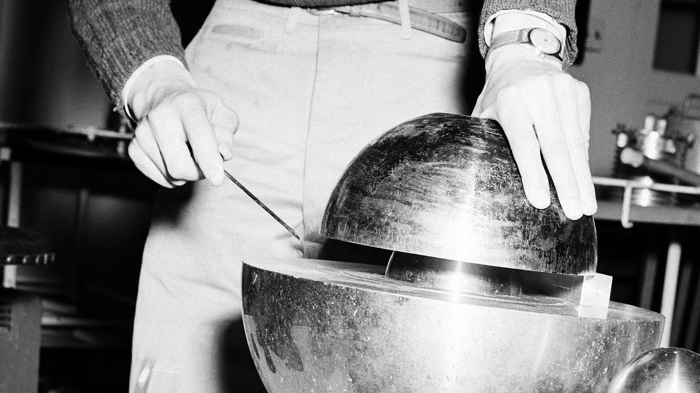
With the recent release of the biopic Oppenheimer, now is an excellent time to talk about the history related to the Manhattan Project. When we think of the destructive power of the Manhattan Project, we usually think of the two bombs that were dropped on Hiroshima and Nagasaki. However, such immense destruction was not exclusive to bomb sites and inhabited cities.
As it turns out, humans were forced to experience the terrifying power of the Manhattan Project first-hand, on themselves, in a lab. Let’s talk about the “demon core.”
You may or may not be aware that there were actually plans for a third atomic bomb to be used on Japan during World War II. The core to be used for the bomb was already prepared, but the plan was called off after Japan’s surrender. Now what might the U.S. have done with this core? Well, the core was kept in Los Alamos for scientific research and testing. But don’t be mistaken, regardless of how it was used, this core was determined to bring about the loss of human life, as we will soon learn.
The core was nicknamed “Rufus,” and I will address it by this name several times for dark comedic effect. A simple plutonium sphere 3.5 inches in diameter and weighing roughly 14 pounds, Rufus may have looked uninteresting to the average person but was nonetheless deadly, especially under the right circumstances. By design, Rufus was a subcritical mass, and though it would be used in a variety of experiments, allowing Rufus to become a critical mass was a big no-no. That is to say, even the slightest slip-up when handling the core could expose you to extreme levels of radiation—emphasis on extreme.
There were two times when the demon core was accidentally allowed to go critical. The first incident was on August 21, 1945, and the second was on May 21, 1946.
The 1945 incident featured physicist Harry Daghlian, who was working alone late at night on a criticality experiment. Because he was trying to build a neutron reflector, Daghlian used tungsten carbide bricks which he continuously added around the core, each one adding further neutron reflection. Daghlian accidentally dropped one of the bricks and pushed the core into supercriticality. Immediately he disassembled the pile, which only increased his total radiation exposure. He died less than a month later as a result of acute radiation poisoning.
The 1946 incident is probably the more famous of the two. Another physicist, Louis Slotin, was demonstrating his own criticality experiment, though in this case he was accompanied by seven other individuals. Slotin, who was already known for his dangerously casual approach to his work, carried out the experiment differently. He kept the two halves of the sphere around the demon core apart using only a screwdriver. In theory, this would allow the experiment to get much closer to criticality, yet it was incredibly dangerous since allowing the halves to touch would result in supercriticality.
Other scientists said that Slotin was “tickling the dragon’s tail.” To his credit, Slotin had performed similar experiments several times before without issue. And yet, on that fateful day in 1946, Rufus breathed fire. The screwdriver in Slotin’s hand slipped and the halves of the sphere collided, initiating supercriticality. A horrific blue glow emanated from the sphere as the demon core awoke.
Instantaneously, Slotin was exposed to roughly 1,000 rads of radiation. For context, it takes less than half that amount to kill most people. Though Slotin reacted quickly enough to separate the spheres and prevent his fellows from receiving just as much radiation, he did not last long. Slotin died merely nine days later after being ravaged by radiation sickness.
Rufus was not long for this world after these two tragedies. Soon after the incident with Slotin, the demon core was melted down. The silver lining is that these events helped bring about improved safety procedures for these kinds of studies. From then on, all scientists had to be at least a quarter-mile away from the radioactive subject.
Safety guidelines are very important. Let’s all be glad that we didn’t need to learn this lesson from the “demon” Rufus personally.
— r
Further reading:
There is an available interview with Raemer Schreiber, who was present in the room when Slotin’s screwdriver slipped and the demon core went supercritical. It goes without saying that this provides a unique look at the incident, but the hour-and-a-half-long interview offers that and more.

 Mysterious History