
For most people, music is something to relax us, to energize us, to enjoy for the sound and lyrics and little else. Generally, music is not something that one would find “mysterious.” Despite this, music is just one of many art forms, alongside literature, illustration, and many more, and we have seen on Mysterious History that these types of art can be susceptible to mystery all the same.
This week, we’ll be looking at pieces of music that have, for one reason or another, been marked with mystery.

We’ll begin by looking at an older piece: Giuseppe Tartini’s Violin Sonata in G minor. Lasting around 15 minutes, this solo violin piece is not only beautiful to behold, but it is also said to be remarkably difficult to perform. Giuseppe Tartini was an Italian composer from the 18th century who composed hundreds of pieces, including over one hundred for the violin. An impressive career, to be sure—so why is Tartini most well-remembered for this piece?
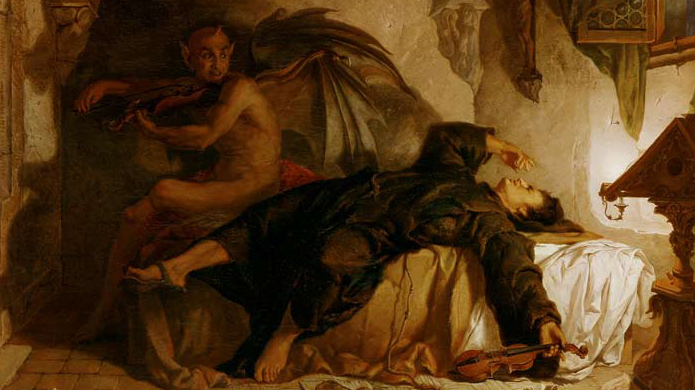
The Violin Sonata in G minor’s alternative name is also its more well-known moniker: the “Devil’s Trill Sonata.” According to legend, Tartini dreamt that the Devil himself visited him and made a pact with the violinist. Tartini gave the Devil his violin and he began to play a sonata so perfect and beautiful that Tartini thought it the greatest he had ever heard. When Tartini awoke abruptly, he rushed to his violin to try and retain the music the Devil had played for him in his dream. The result of this attempt to capture the Devil’s music would become the Devil’s Trill Sonata that we know today.
While it is undeniable that Tartini’s sonata is an artistic marvel, Tartini himself professed that it was so far removed and inferior to what he had heard from the Devil that he considered abandoning music forever.
Mysterious History has looked at a similar story before in the case of the “Devil’s Bible,” and once again, it is likely that the truth of this sonata is less fantastical. However, considering Tartini’s story, this seems more plausible in the sense that Tartini may have indeed had a dream where he envisioned this perfect piece and immediately afterward tried and failed to recreate it. After all, who could perfectly replicate their own dreams? No matter the true story, it is still eerie, unsettling, and even alluring to imagine the origins of this piece while listening to it alone on a dark night.

We now jump forward in time to the year 1933. The song “Gloomy Sunday” is published, having been composed by the Hungarian Rezső Seress. Today, this song is commonly remembered as the “Hungarian Suicide Song.”
The original lyrics delved into the sadness of war, while the revised, more well-known lyrics focused on the despair of a man whose lover had died. “Gloomy Sunday” was eventually translated into English and was even sung by the likes of Paul Robeson and Billie Holiday. The piece has only garnered more and more attention over the decades, but what about that grim name it’s known for?
A persisting legend attests that “Gloomy Sunday” has been tied to a series of suicides due to hearing the piece. It is also claimed that radio stations have worked to ban the song as a result. There are a few details that draw attention here, such as how Billie Holiday’s version was considered bad for wartime morale, or how the composer himself took his own life decades after writing the piece.
Despite the notable amount of Hungarian deaths supposedly attributed to “Gloomy Sunday,” there is little reason to blame the song directly. The Great Depression and fascist takeovers were weighing heavy on Hungarians at the time, so it is much more likely that “Gloomy Sunday” was simply brought about by this despair rather than causing it directly.

Lastly, we’ll be looking at a piece that most accurately fits the description of “mysterious music.” After all, in absence of a true name, it is known as “The Most Mysterious Song on the Internet.” This song, believed to have come from the 1980s, has been the subject of a years-long internet search project to uncover its true name and the identity of its creator. The oldest known recording of the song allegedly came from a West German radio station. Though most agree that the singer is European, no one knows their identity.
Entire online communities have been formed around this mysterious song. Because of the audio quality, we can only guess as to the true lyrics, yet the lyrics which can be salvaged have led to some fan names, like “Blind the Wind” and “Check It In, Check It Out.” The fact that in the age of the internet, where it is considered harder to be anonymous than to be known, this piece of music has continued lying in obscurity is quite amazing.
Considering the popularity behind the search for this song’s origin, it is certainly possible that we will finally learn its true name and artist in the coming years. At the same time, what does it imply that the author has not yet come forward despite all the attention? Perhaps they are no longer with us. Maybe they’d rather keep their anonymity.
Until then, you can listen to a recording of “The Most Mysterious Song on the Internet” to pass the time with this mystery.
— r
Further reading:
Of course, since we’re talking about music, it’s only proper that you’re provided a way to listen to them yourself. Enjoy!
“The Devil’s Trill Sonata” by Giuseppe Tartini
“Gloomy Sunday” by Rezsö Seress (Hungarian version)

 Mysterious History