
Is it possible for you to picture the two opposing sides in the ongoing war in Ukraine mutually agreeing to a temporary truce, sitting down and sharing champagne? What about U.S. and Iraqi troops over a decade ago? Or maybe even any of the soldiers involved in World War II?
Your answer is probably a strong “no,” and I think most people can agree with that.
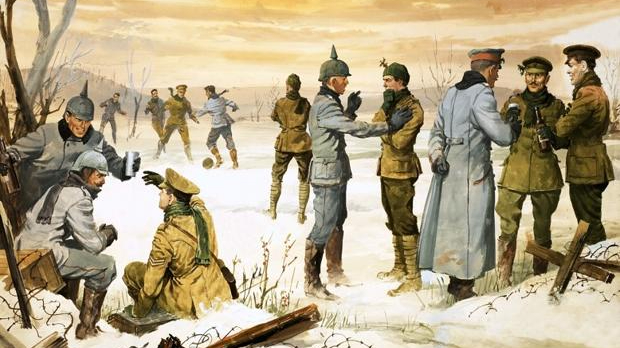
In the winter of 1914, several soldiers on the Western Front of the First World War briefly ceased their fighting to celebrate Christmas in the trenches together, and afterward it never happened again in any meaningful capacity. Today is Memorial Day in the United States, and though this holiday is reserved for honoring U.S. soldiers, I feel it’s an appropriate time to talk about something utterly baffling: a brief peace amidst one of the deadliest wars in human history.
To set the scene, in December 1914, life in the trenches was even worse than usual. Constant rain flooded the land with mud, and in time, bitter snow would come as well. Starting at least as early as the 23rd of December, German soldiers began singing Christmas carols alongside the Christmas trees that they had been sent by Kaiser Wilhelm II in order to improve morale. In time, the opposing British soldiers began to respond, be it through shouting over to the Germans or even responding with their own carols.
On Christmas Day, soldiers came out from the trenches and waved their arms to show that they meant no harm. As tension gave way to relief, a cautious kind of merriment soon followed. Soldiers chatted (aided by Saxon translators), ate, drank, and according to some, even played football with each other.
What caused this to happen? We could possibly look to the newly appointed Pope Benedict XV, who futilely appealed to the European powers to request a truce for the holy Christmas Day. These “festivities” could be seen as the soldiers’ way of trying to capture the peace their leaders were not willing to allow. It’s also worth noting that these men were undergoing an incredibly stressful experience in the trenches, and a homely (if only brief) peace must’ve been enticing. Additionally, as I’ll talk more on briefly, this was still before the true extent of the war’s brutality and misery would surface.
Public response to the Christmas truce was quite divided. This was the age of propaganda, and so the idea that these men who’d been just recently fighting their demonized enemies could suddenly sing and drink with them was nigh unbelievable. Many refused to believe it even took place until photographs began to emerge—though truthfully, there are still people who deny or downplay it to this day. Most importantly, the governments at war were not thrilled and measures were taken to prevent such a truce from happening again. The Christmas of 1914 was not only a disruption for their war effort, but also a contradiction for their propaganda machines portraying the enemy as monsters.
The 1914 Christmas truce never saw a real reprisal throughout the rest of the war, and there are clear reasons why. As mentioned, the warring powers had no love for the truce and they took action to prevent another one. A grim fact we must note is that, in the scope of World War I as a whole, these men were naïve as to what was to come. Chemical weapons, artillery, and the darkest depths of trench warfare were still yet to come—the first year of the war hadn’t even ended yet. It could be said that these men were still at the point where they could look at their foes fairly as fellow humans. What they would soon face would strip that away. One other point is that the truce itself was not incredibly common, and it relied heavily on favorable circumstances in order to take place. There was no such truce on the Eastern Front with the Orthodox Russians, and even elsewhere on the Western Front, many were unwilling to entertain a temporary peace with the men they were supposed to be killing.
This kind of brief peace hasn’t been seen to any proper extent in the world since 1914. Why is that? Have people simply become crueler, colder, and less trusting? Maybe, but what’s important to note is that global circumstances have changed drastically. It’s harder to trust your enemy with the kinds of weapons men are capable of today. There are also fewer conflicts being fought between groups as close as the British and Germans. Most people fighting today have different cultures, religions, ancestries, and values. This is merely a reductive list of reasons for why such a truce has never reappeared, as to truly capture why would take far, far longer.
With all that being said, let us at least recognize that these men were able to experience a kind of peace and fellowship, however brief and awkward, even whilst fighting in the deadliest (at that time) war in history. They got to experience something that may very well never occur again.
— r
Further reading:
IWM’s video on the 1914 Christmas truce (12 min.) provides a succinct summary with further details, including photographs and interviews with soldiers who were actually there.
David R. Woodward’s “Christmas Truce of 1914: empathy under fire” is a brief essay that includes the words of soldiers who experienced this event, and it’s quite appealing if you really want to know what some of these men were thinking in the moment.

 Mysterious History